Drive through any American suburb in 1985 and you'd see the same thing on every block: an endless carpet of green perfection stretching from sidewalk to front door. These weren't just yards—they were statements. Manifestos written in Kentucky bluegrass that declared to the world that the people inside had figured out how to live properly.
Today, that same pristine lawn has become something closer to a scarlet letter, marking its owner as either environmentally ignorant or willfully destructive. The transformation of America's relationship with its front yards tells the story of how quickly cultural symbols can flip from aspiration to accusation.
The Suburban American Dream, Measured in Square Feet of Green
In post-war America, the perfect lawn wasn't just landscaping—it was proof of concept for the entire suburban experiment. After decades of depression and war, families who had scraped by were suddenly able to afford not just houses, but houses with enough extra land to grow something purely decorative.
The lawn became the visual shorthand for economic stability, social responsibility, and good citizenship all rolled into one. A brown patch in July didn't just suggest neglect; it hinted at deeper character flaws. Neighbors would literally judge your worthiness as a community member based on whether your grass edges were properly trimmed and your dandelions promptly eliminated.
This wasn't accidental. The lawn care industry, chemical companies, and suburban developers all had financial incentives to promote grass as the only acceptable ground cover. By the 1960s, they'd succeeded in making lawn maintenance feel like a patriotic duty. A well-kept yard was evidence that you were doing your part to maintain property values and community standards.
The Weekend Warriors
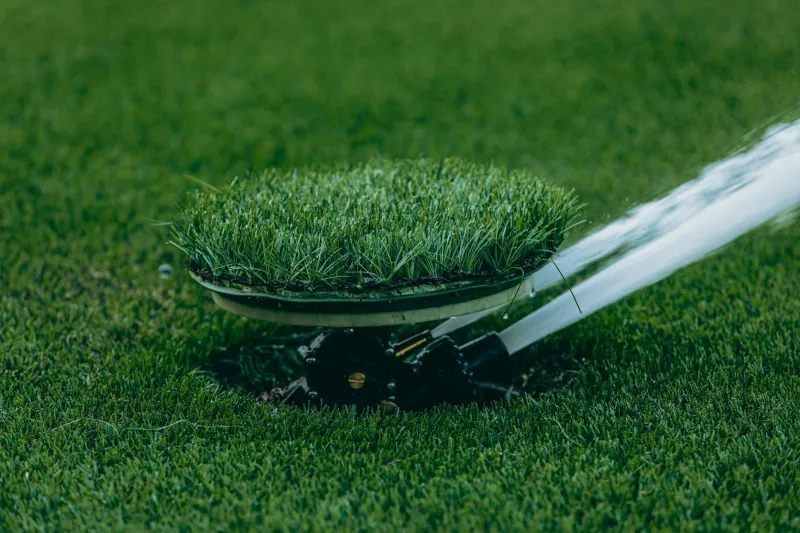
Saturday mornings in suburban America used to sound like a symphony of small engines. Mowers, edgers, leaf blowers, and sprinklers created the soundtrack of responsible homeownership. Fathers taught sons the proper mowing pattern—alternating diagonal stripes one week, straight lines the next—like passing down sacred knowledge.
The time investment was enormous. Between mowing, watering, fertilizing, weeding, and seasonal treatments, maintaining a picture-perfect lawn consumed 4-6 hours every weekend from March through October. This wasn't seen as a burden but as a privilege—the luxury of having enough property to require that much maintenance.
Hardware stores built entire business models around this weekend ritual. The spring fertilizer aisle was a gathering place where neighbors compared notes on crabgrass prevention and shared tips for achieving that perfect shade of green. Lawn care became a hobby, a competition, and a form of meditation all at once.
The Chemical Promise
By the 1970s, American lawns had become dependent on an arsenal of chemicals that would have impressed industrial agriculture. Pre-emergent herbicides, post-emergent herbicides, fungicides, insecticides, and synthetic fertilizers turned every suburban yard into a miniature chemical laboratory.
Homeowners embraced this complexity because it worked. The results were undeniably impressive—grass so green it looked artificial, so uniform it resembled outdoor carpeting. The chemicals promised to eliminate every variable that might interfere with perfection, from dandelions to grubs to seasonal color variations.
Lawn care companies emerged to serve families who wanted the results without the effort. By the 1980s, professional lawn services were treating millions of American yards with chemical cocktails designed to create biological monocultures—single species of grass with no competition from any other plant life.
When the Tide Turned
The shift happened gradually, then suddenly. Environmental awareness that had been building since the 1960s finally reached the American lawn in the 1990s and 2000s. Scientific studies began connecting suburban chemical use to water pollution, wildlife decline, and human health problems.
Suddenly, that perfect green carpet started looking less like success and more like ecological destruction. The same neighbors who once bonded over fertilizer schedules began whispering about the environmental cost of maintaining grass in climates where it had no business growing.
The drought years hit hardest. When California, Arizona, and Texas started imposing water restrictions, the absurdity of flooding non-native grass species became impossible to ignore. Homeowners were literally watering decorative plants while being told to take shorter showers.
The New Judgment
Today, the social pressure has completely reversed in many communities. The neighbor with the perfectly maintained chemical lawn is now the one facing judgment, not praise. Homeowner associations that once fined residents for brown spots are being challenged by members who want to plant native species or install drought-resistant landscaping.
The rise of "No Mow May" and native plant gardening has created a new kind of lawn shame—not for having weeds, but for not having enough biodiversity. Social media feeds that once showcased pristine grass now celebrate wildflower meadows and pollinator gardens.
Younger homeowners, in particular, view traditional lawn maintenance as an outdated practice that wastes time, money, and resources while contributing nothing meaningful to the ecosystem. The weekend hours their parents spent on lawn care are now seen as time that could be better spent on literally anything else.
The Resistance Movement
Not everyone has gotten the memo about lawns being environmentally problematic. In many American communities, the old standards still apply. HOA covenants written decades ago still require grass and prohibit native alternatives. Municipal codes in some cities actually mandate lawn maintenance and fine homeowners for letting their grass grow too long, even if they're trying to establish a natural habitat.
This has created a cultural divide that often breaks along generational lines. Older residents who invested decades in perfecting their lawns see the new anti-grass movement as an attack on everything they worked to build. Younger residents see lawn maintenance as a pointless ritual that prioritizes appearance over substance.
What Comes Next
The American lawn isn't disappearing entirely, but it's definitely evolving. Smaller grass areas, native plant borders, and drought-resistant alternatives are becoming more common even in traditional suburban neighborhoods. Some communities are updating their HOA rules to allow for environmental landscaping.
What's fascinating is how quickly the symbol flipped. In just one generation, the American lawn went from representing success and responsibility to representing waste and environmental ignorance. The same green carpet that once said "I've made it" now whispers "I haven't figured it out yet."
The transformation reflects broader changes in how Americans think about consumption, environmental responsibility, and what it means to be a good neighbor. The perfect lawn was never really about the grass—it was about demonstrating that you had the time, money, and commitment to maintain something purely for appearance. Today, those same resources feel better spent on sustainability rather than status.