A Pinch of This, A Prayer of That: The Handwritten Recipe Cards That Fed America's Families
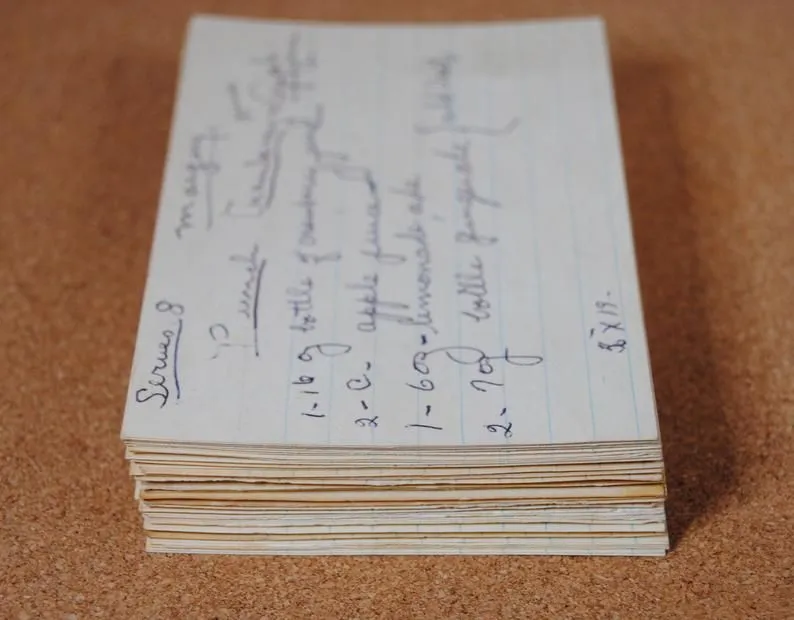
Photo: vintage handwritten recipe cards on wooden table with flour, via i.pinimg.com
A Pinch of This, A Prayer of That: The Handwritten Recipe Cards That Fed America's Families
Somewhere in a kitchen drawer right now, tucked behind a tangle of rubber bands and expired coupons, there might be a stack of index cards in faded ink. Maybe a few are spotted with old grease stains. Maybe one is written in a handwriting you'd recognize anywhere — your grandmother's looping cursive, your mother's tight print. If you have them, you probably treasure them. And if you've ever tried to actually cook from one, you know the quiet panic of reading "season to taste" and realizing you have absolutely no idea what that means.
For most of American history, that was just cooking.
The Kitchen Was a Classroom Without Walls
Before the Food Network existed, before YouTube tutorials walked you through knife technique in real time, and long before an app could calculate your exact macros, American home cooks learned by standing next to someone who already knew how. Mothers taught daughters. Grandmothers taught everyone. The kitchen was a place of apprenticeship, and the recipe card — if one existed at all — was more of a memory aid than an actual instruction set.
The measurements reflected this. "A good handful of flour." "Cook until it smells right." "Add butter — you know how much." These weren't careless directions. They assumed the reader had already watched the dish being made a dozen times, had already burned it once, had already learned through their hands what the written words couldn't fully capture. The card was a shorthand for knowledge that lived in the body, not on the page.
Many recipes weren't written down at all. They existed entirely in oral tradition — passed from mouth to ear, adjusted every season, quietly altered by whoever was doing the cooking that year. When those cooks were gone, the recipes often went with them. Whole dishes simply disappeared from family tables, remembered only as a taste someone couldn't quite place anymore.
The Intimacy Built Into Every Stain
What made those handwritten cards so different from anything we use today wasn't just the format. It was the evidence of use. A recipe card that had been made a hundred times looked like it. The flour dust, the butter smear on the corner, the ink that had faded because the card spent decades near a hot stove — these were physical proof that someone loved this dish enough to make it over and over again.
There was also a kind of intimacy in the personalization. Cards were often annotated across generations. A mother's original recipe in blue ballpoint, a daughter's note in pencil — "add more vanilla, trust me" — and maybe a grandchild's scrawl along the margin that said "Dad's favorite." A single index card could carry thirty years of family history in its margins.
You couldn't search for that on Google. You couldn't replicate it in an app. The imprecision that frustrated modern cooks was actually the point — because decoding the recipe meant you had to have known the person who wrote it, or at least known someone who did.
When Recipes Became Exact
The shift toward precision cooking happened gradually, then all at once. Standardized measuring cups became common in American kitchens in the early twentieth century. Cooking shows in the 1950s and 60s began demonstrating exact techniques to a national audience. And then the internet arrived and turned recipe culture into something almost scientific — user ratings, calorie counts, prep times down to the minute, and comment sections where strangers debated whether two cups of broth was really enough.
The precision is genuinely useful. Recipes today are more reliable, more reproducible, and more accessible than they've ever been. Someone with no culinary background can open an app, follow a step-by-step guide with embedded video, and produce a credible beef bourguignon on their first attempt. That's remarkable. A generation ago, it would have seemed almost magical.
But something shifted in the exchange. Cooking became a task to complete rather than a tradition to inhabit. The recipe became the authority instead of the person standing next to you. And the knowledge that used to flow between generations — the kind that required proximity and patience — stopped flowing quite so naturally.
What Gets Lost in Translation
Talk to anyone who has tried to reconstruct a family recipe from memory or from a vague card, and you'll hear the same kind of story. They made it six times before it tasted right. They called an aunt three states away to ask what "medium heat" meant on a 1940s gas stove. They eventually gave up and accepted that their version was close, but not quite the same.
That gap — between the original and the recreation — is where the grief lives. Because the recipe was never really about the food. It was about the person who made it, the kitchen it came from, the Sunday afternoons it represented. The dish was a vehicle for memory, and when the memory became inaccessible, the dish changed too.
Some families have started scanning and archiving old recipe cards, which is a lovely impulse. But a high-resolution scan of a handwritten card still can't tell you what "season to taste" meant to the woman who wrote it, or why she always added a splash of something at the end that she never wrote down.
The Drift Between Generations
There's a particular kind of loss that comes not from something disappearing suddenly, but from something slowly becoming less necessary. We didn't stop cooking together because of any single invention. It happened incrementally — a cooking show here, a convenience food there, a move to a new city that made Sunday dinners less frequent, and eventually a phone full of recipes that never required you to ask anyone anything.
The handwritten recipe card didn't just hold a dish together. It held a relationship together — a reason to call, a reason to visit, a reason to stand in someone's kitchen and watch how they do it. When the card became unnecessary, so did some of that contact.
The food still gets made. It often tastes great. But somewhere between the app and the table, the story got edited out.