The Invisible Hours: How Much of Your Life America Once Asked You to Spend Standing in Line
Time Nobody Counted
There's a version of daily life in America that's become almost impossible to fully reconstruct in memory — not because it was dramatic or traumatic, but because so much of it consisted of simply standing still.
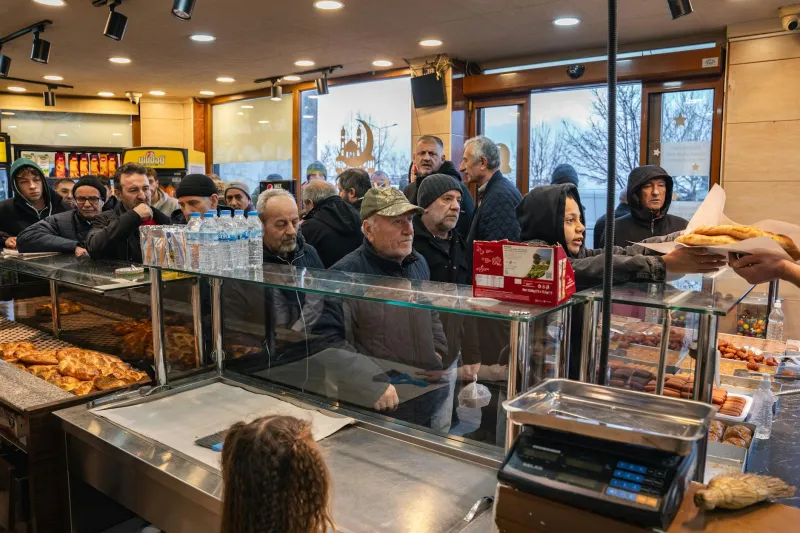
Waiting at the bank on a Friday afternoon, shifting your weight from foot to foot behind six other people, watching the teller work through each transaction by hand. Sitting in a plastic chair at the DMV for two hours to update your address. Calling your doctor's office and being told the next available appointment was three weeks out, then showing up anyway and waiting another forty minutes past your scheduled time.
This was just life. It was the friction built into every basic transaction, the invisible overhead cost of participating in modern society. Nobody really measured it. Nobody called it a crisis. It was simply the way things worked, and you arranged your week around it.
Friday Afternoon at the Bank
For most of the 20th century, if you needed cash for the weekend, you went to the bank on Friday. And so did everyone else.
Banks operated on strict hours — typically 9 a.m. to 3 p.m. on weekdays, sometimes a half-day on Saturday. If you missed that window, you were out of luck until Monday. There were no ATMs until the late 1970s, and even then, adoption was slow and coverage was limited. For most Americans well into the 1980s, getting cash meant physically going to your branch, waiting in line, and conducting your transaction with a human teller who had to look up your account manually.
Friday afternoons were notorious. Workers collecting paychecks, families preparing for weekend errands, small business owners depositing the week's receipts — everyone arrived at roughly the same time, and the lines stretched to the door. Banking wasn't a two-minute errand. It was something you blocked out time for.
The ATM changed this incrementally. Online banking, which became mainstream in the early 2000s, changed it fundamentally. Today, a transaction that once required a dedicated trip and thirty minutes of waiting takes fifteen seconds on a phone. The bank's hours are irrelevant. The line doesn't exist.
The DMV as a Cultural Landmark
If the Friday bank line was an inconvenience, the Department of Motor Vehicles was an institution. Waiting at the DMV became so embedded in American culture that it functioned as shorthand for bureaucratic misery — a shared experience universal enough to anchor jokes, movies, and complaints at dinner tables across the country.
The reasons were structural. The DMV handled an enormous volume of transactions — license renewals, title transfers, registration updates, new driver testing — with staffing levels that rarely matched demand. Everything required paper forms filled out in person. Every transaction required a clerk to manually process and file. The concept of scheduling your visit in advance barely existed; you simply showed up and waited your turn.
Studies from the 1990s and early 2000s estimated that Americans spent an average of 45 minutes to over two hours at the DMV per visit, with peak periods stretching considerably longer. Multiply that across the driving-age population renewing licenses and registrations on staggered cycles, and the aggregate hours lost were staggering.
Online renewal portals, introduced gradually through the 2000s and 2010s, have made the physical DMV visit optional for a growing range of transactions. Appointment systems have replaced open queues in many states. The two-hour wait hasn't vanished, but it's no longer the default experience for routine tasks.
The Doctor's Office and the Art of the Wait
Healthcare waiting had its own particular texture — different from the bank or the DMV because the stakes felt higher, and because the wait happened in two separate stages.
First, you waited weeks for the appointment itself. Primary care physicians in most American communities operated at or near capacity through much of the late 20th century, and scheduling a non-urgent visit often meant looking at a calendar three or four weeks out. If you had a concern that didn't rise to the level of an emergency room visit but felt more pressing than that, you simply waited and hoped it didn't get worse.
Then, when the appointment day finally arrived, you waited again. The waiting room was where you actually spent most of your time — reading outdated magazines, watching the clock, listening for your name. A 10 a.m. appointment might not become a patient-doctor conversation until 10:45. Physicians running behind schedule was so routine that patients built the buffer into their planning automatically.
Telehealth existed in limited forms before 2020, but the COVID-19 pandemic accelerated its adoption by years in a matter of months. Millions of Americans had their first video appointment during the pandemic and discovered that a conversation with a doctor didn't require driving across town, sitting in a waiting room, or taking half a day off work. Urgent care clinics with online check-in, retail health clinics in pharmacies, and app-based primary care services have further compressed the time cost of routine healthcare access.
The Compound Effect
What made the old waiting culture significant wasn't any single line or any single wait. It was the compound effect across a week, a month, a year.
Consider a single month in, say, 1988. You go to the bank twice — an hour total. You renew your car registration at the DMV — ninety minutes. You pick up a prescription at the pharmacy counter and wait while it's filled — twenty-five minutes. You visit your doctor for a routine checkup — two hours including travel and wait time. You stand in line at the post office to mail a package — fifteen minutes.
That's roughly five to six hours of your month spent in various forms of queue, for transactions that today take minutes or happen automatically in the background. Over a year, you're looking at sixty to seventy hours — more than a full work week — spent waiting for access to services that are now largely instant.
This time wasn't experienced as leisure. It was dead time, wedged into working days and weekends, requiring physical presence and active attention while delivering nothing except the eventual completion of the errand.
What Replaced the Wait
The compression of waiting time over the past two decades is one of the least celebrated improvements in everyday American life. It happened incrementally, driven by digital infrastructure, mobile technology, and the simple competitive pressure to make transactions faster. Nobody announced it. There was no ribbon-cutting ceremony for the end of the Friday bank line.
But it returned something real to people — not dramatically, not all at once, but hour by hour, errand by errand. Time that used to disappear into queues is now available for other things. The friction that shaped how Americans organized their days has largely dissolved.
What we don't often reflect on is how much of ordinary life used to be organized around that friction — and how completely, in the space of a single generation, the rhythm of daily life changed.