Pass the Potatoes, Pass the News: When the Dinner Table Was America's First Social Network

Somewhere around 6:30 on a weeknight in 1974, tens of millions of American families were doing the same thing: sitting down together to eat. The television was off, or in another room, or didn't exist yet in the way it would later. The phone was on the wall, and if it rang during dinner, some families didn't answer it.
For an hour or so, the family was just — together. Talking, or not talking. Arguing, or laughing, or sitting in the particular silence of people who know each other well enough not to need words. It wasn't a curated experience. It wasn't scheduled wellness time. It was just dinner.
And it was quietly holding everything together.
The Table as Information Hub
Before the internet democratized information, families were each other's primary news source.
Dad came home from the plant and mentioned that the Hendersons were moving. Mom reported that the school was switching lunch providers. The oldest kid had heard something about the new family on Elm Street. The youngest had no news but had questions — lots of questions — and the table was where they got answered.
This sounds mundane. It was mundane. But it was also how families built a shared picture of the world they lived in. Each person brought a different slice of reality — different workplaces, different classrooms, different social circles — and for an hour every evening, those slices got assembled into something larger.
Children learned things at the dinner table that no school curriculum covered: how adults talked about money when it was tight, how to navigate a disagreement without the conversation falling apart, what it looked like when a grown-up was worried about something and trying not to show it. They absorbed the texture of adult life by proximity, sitting close enough to hear and young enough to still be paying attention.
Conflict Had Nowhere to Hide
Here's something the dinner table forced that modern family life often avoids: confrontation.
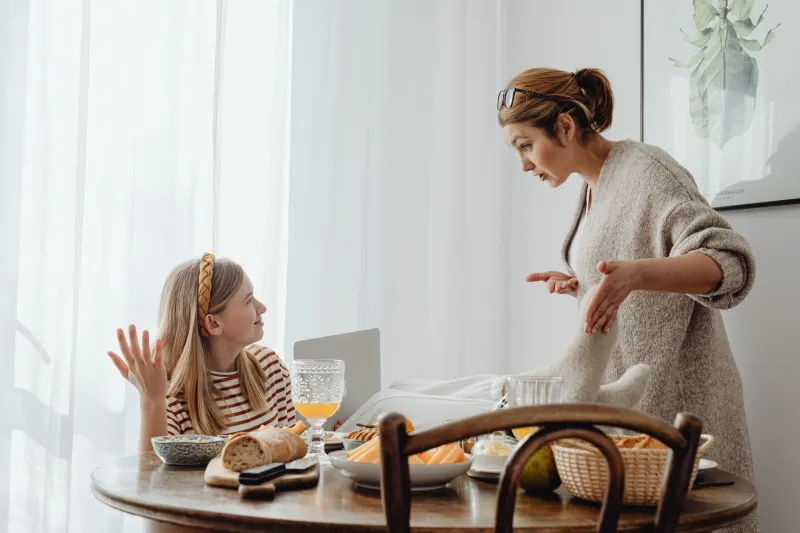
If you were angry at your brother, you still had to sit across from him and pass the bread. If something had gone wrong at school, the question was coming — probably before the second helping. If two parents were in the middle of a disagreement, the children could feel it in the room, and sometimes they watched it get worked through in real time.
None of this was comfortable. But discomfort, it turns out, is part of how families learn to function.
Conflict resolution is a skill. Like most skills, you develop it through practice — through the repeated experience of being in tension with someone you can't simply mute or unfollow, someone you'll be sitting next to again tomorrow night. The dinner table provided that practice on a daily basis. It was a low-stakes arena where families rehearsed the harder work of being in relationship with each other.
When the table became optional — when kids started eating in their rooms, when schedules fragmented, when screens arrived to fill any gap in conversation — that daily rehearsal largely stopped. And families started outsourcing conflict resolution to therapists, school counselors, and the comment sections of family group chats.
The Arrival of the Screen at the Table
Television got there first. By the late 1950s, the TV tray had entered American homes — the little folding table that let you eat dinner while watching your favorite show. It was marketed as convenience. It was, in hindsight, the first significant competitor to family conversation.
For a few decades, the dinner table held on. Plenty of families kept the television out of the dining room, maintained the ritual, kept the hour more or less intact. The TV tray was for special occasions, for sick days, for Saturday night.
Then smartphones arrived, and the competition became impossible to win.
A television is at least a shared experience. Everyone in the room watches the same thing, reacts to the same moments, exists in the same world for the duration of the program. A smartphone is a private portal. When a phone comes to the table, its owner disappears — not physically, but in every way that matters. They're somewhere else: in a group chat, in a feed, in a conversation that has nothing to do with the people sitting next to them.
Studies on family dinner habits in the past decade consistently show the same pattern: families who eat together regularly still exist, but the quality of interaction at those meals has changed. Phones appear. Conversations shorten. The meal ends faster. The hour that once anchored the family day has compressed into twenty distracted minutes.
What the Table Was Actually Doing
Researchers who study child development have spent years documenting what family dinners produce — and the list is longer than most people expect.
Children who regularly eat dinner with their families show higher academic performance, stronger vocabulary, lower rates of substance use, and better mental health outcomes across multiple studies. The effect holds across income levels and family structures. Something about the regular, face-to-face, unstructured time together produces results that are genuinely hard to replicate any other way.
The mechanism isn't mysterious. It's the conversation. The back-and-forth across the table — the questions, the stories, the arguments, the explanations — is language development, emotional education, and social bonding happening simultaneously, disguised as dinner.
You can't get that from a group chat. You can't schedule it as a formal activity. It only works because it's routine, because it's daily, because it's unavoidable.
What We Traded It For
Modern families are, in many ways, more connected than ever. Group texts run constantly. Family members track each other's locations in real time. Parents and college kids talk more frequently than any previous generation.
But there's a difference between connection and presence. You can be reachable every hour of every day and still be fundamentally absent from the people in the same room.
The dinner table didn't just feed families. It put them in the same room, at the same time, without an exit. It forced presence. It made conversation the only available activity. And in doing so, it built something that turns out to be surprisingly hard to build any other way: the daily habit of actually knowing each other.
The potatoes are still getting passed. But a lot of us aren't looking up to see who's passing them.