Saturday Under the Hood: The Weekend Mechanic America Left Behind
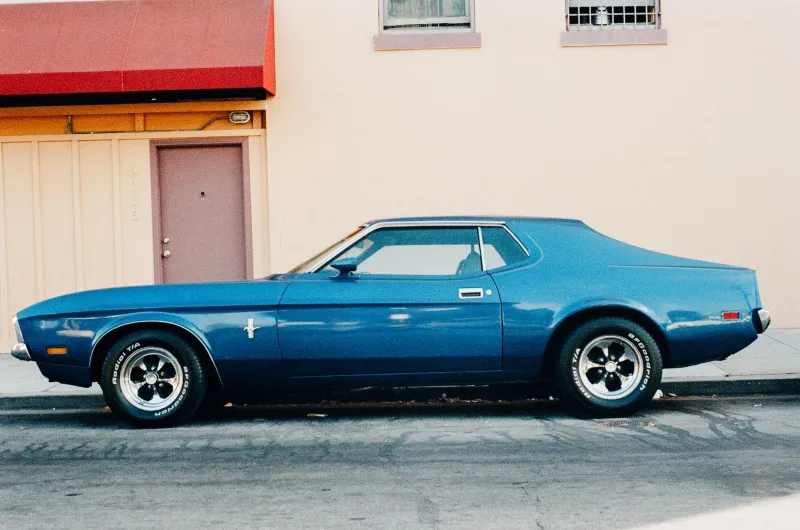
On any given Saturday morning in suburban America in the 1970s, you could walk down a residential street and find at least one driveway with a car hood propped open and a pair of legs sticking out from underneath. The radio would be on. There'd be a Folgers can full of bolts on the concrete. Maybe a kid handing tools up from a red Craftsman box.
This was normal. This was expected. This was what you did.
Today, that same repair would require a laptop, a proprietary software license, and possibly a dealership appointment. The car hasn't just gotten more complicated — the entire relationship between Americans and their vehicles has been quietly rewritten.
When a Car Was Something You Could Know
The cars of the postwar era through roughly the early 1990s were mechanical in a way that rewarded curiosity. Engines were large, accessible, and logical. The carburetor mixed air and fuel in a way you could see and adjust with a screwdriver. The distributor cap and spark plugs were right there. Drum brakes, then disc brakes — both understandable by anyone willing to spend a Saturday afternoon with a repair manual and some patience.
Chilton and Haynes published manuals for virtually every make and model, written for people with no formal training. You bought the manual for your specific car, you read the relevant section, and you did the work. Millions of Americans changed their own oil, replaced their own brake pads, adjusted their own timing, and swapped out their own alternators — not because they were gearheads, but because it was cheaper and because it wasn't that hard.
The car was a thing you could understand. And understanding your car meant something.
The Slow Creep of the Computer
It didn't happen overnight. The shift began in the early 1980s when manufacturers started integrating basic electronic controls into engines. By the late '80s, the OBD — On-Board Diagnostics — system began appearing in vehicles, and by 1996, federal law required all cars sold in the US to include a standardized OBD-II port.
In theory, this was great. The car could now tell you what was wrong with itself, in code form, which a scanner could read. In practice, it was the beginning of the end for the backyard mechanic.
Because the codes were just the start. Modern vehicles run on dozens of interconnected computer modules — engine control units, transmission control modules, anti-lock brake systems, stability control, fuel injection management — all communicating constantly. Replacing a component isn't just a matter of swapping parts anymore. The new part often has to be programmed to the vehicle. The system has to be reset. The calibration has to be verified.
None of that happens with a wrench.
What the Dealership Became
For most of American automotive history, the dealership was where you bought the car. Repairs happened at independent shops, in driveways, at the corner garage where a guy named Bud had been working since 1962 and could diagnose an engine knock by sound alone.
As vehicles became more software-dependent, that landscape shifted. Independent shops had to invest heavily in diagnostic equipment just to stay competitive. Some did. Many couldn't — and they closed. The dealers, meanwhile, had proprietary access to manufacturer software that independents often couldn't legally obtain.
The result: a quiet transfer of economic power. Routine maintenance that once cost you a Saturday afternoon and $40 in parts now runs several hundred dollars at a service center. A warning light that might indicate something minor — or might indicate something serious — requires a diagnostic scan that costs money before any actual work begins. You're not fixing the car anymore. You're paying someone to interpret it.
The Loss Nobody Talks About
The practical costs are real, but there's something less tangible that got lost too.
Working on your own car taught things that had nothing to do with cars. It taught you that complicated systems could be understood if you were patient. It taught you to read instructions carefully, to think through cause and effect, to accept that you might make a mistake and have to back up and try again. It gave fathers and sons — and increasingly daughters — a shared project and a shared language.
There was also a particular kind of pride in driving something you'd fixed yourself. The squeal that came from the front left wheel had been your problem, and you had solved it, and now it was quiet, and you knew exactly why. That's not a small thing. That's the kind of competence that builds confidence in other areas of life.
Now, that squeal means making an appointment, dropping the car off, waiting for a call, and approving a repair estimate you have almost no ability to evaluate. You're not a participant in the process. You're a customer.
The New Tinkerers
It's worth noting that the spirit of the weekend mechanic hasn't entirely disappeared — it's just migrated. Electric vehicles, ironically, are simpler mechanically than gas-powered cars (fewer moving parts, no transmission in the traditional sense), and a growing community of EV enthusiasts is starting to explore what's serviceable at home. A different generation of tinkerers is emerging, working on different problems.
But for the vast middle of American car ownership — the person who just wants to understand what they're driving and feel some agency over it — the gap between driver and vehicle has never been wider.
The hood still opens. There just isn't much point in looking.