Friday Night at the Video Store Was Never Really About the Movie
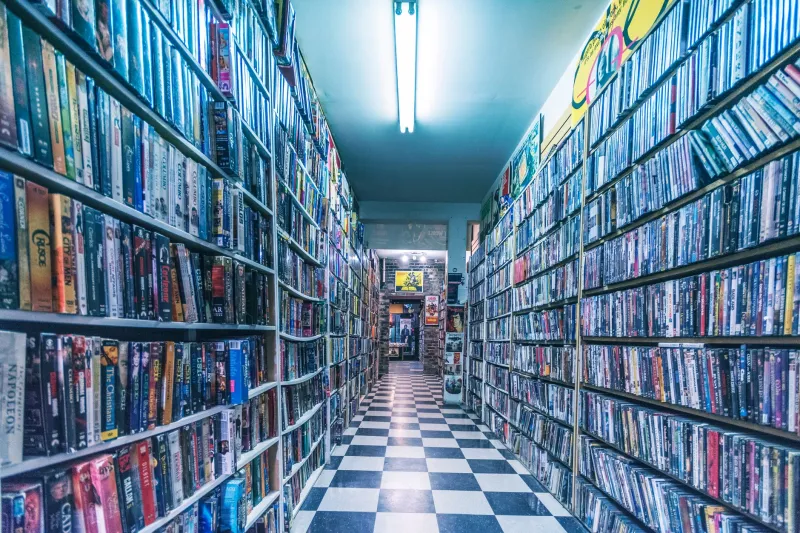
You know the feeling, even if you haven't thought about it in years. The automatic doors sliding open. The slightly stale smell of carpet and plastic cases. The rows of VHS tapes — and later DVDs — organized by genre in a way that was both logical and somehow mysterious. The cover art staring back at you like a challenge.
This was the American video rental store at its peak, and for roughly two decades — from the early 1980s through the mid-2000s — it was the center of the country's weekend entertainment life. Not just a place to get a movie. A place to make a decision, negotiate with whoever you came with, and occasionally stumble onto something you never would have found otherwise.
Streaming killed the video store in the most efficient way possible: by making it completely unnecessary. And in doing so, it may have ended something that had very little to do with the movies themselves.
The Constraint Was the Feature
Here is the thing about browsing a physical video store that doesn't survive translation into the streaming era: you were working with a limited inventory, and that limitation was secretly doing you a favor.
Your local Blockbuster stocked maybe a few thousand titles on any given night. A smaller independent store might carry even fewer. Whatever you walked out with had to come from that selection. If the movie you wanted was already checked out — and the popular ones always were on Friday nights — you had to pivot. You had to look at what was actually available and make a different choice.
This sounds like a frustration, and in the moment it often was. But the pivot was where discovery happened. You'd reach for the new release and find it gone, then let your eyes drift sideways to something with a cover that caught your attention — a foreign film you'd vaguely heard of, a thriller from five years ago that someone had mentioned once, a comedy in a genre you didn't usually watch. You took a chance because the alternative was going home empty-handed.
Algorithms don't work this way. Netflix and its competitors are built around surfacing things you are likely to enjoy based on what you've already watched. It's a sensible approach, and it works. But it's fundamentally different from the sideways glance at an unfamiliar cover and the shrug that said, why not. The algorithm optimizes for comfort. The video store created the conditions for surprise.
The Employee Pick Was a Sacred Institution
In the independent video stores — and even in some of the chains — there was a section that had no equivalent in the streaming world: the staff recommendations.
Handwritten index cards taped to the shelf. A small section near the register where employees had pulled titles they thought deserved attention. A note that said something like: This one flew under the radar in 1994. Watch it on a rainy night. — Dave.
This was curation in the most human sense of the word. Not an algorithm trained on viewing patterns, but an actual person with actual taste making a case for something they believed in. The good video store employees were minor local celebrities in this way — people whose judgment you trusted, whose picks you looked for, whose enthusiasm for an obscure Japanese horror film or a forgotten Western made you feel like you'd been let in on something.
Streaming services have tried to replicate this with editorial lists and curated collections, and they're not bad. But there's a difference between reading a recommendation on a screen and having a teenager behind a counter look you in the eye and say, trust me on this one. One is content. The other is a relationship.
The Shared Event
What made the video store genuinely communal was that everyone in the neighborhood was working from the same limited pool.
When a movie was huge — when Titanic came out on VHS, or The Matrix, or any number of films that the whole country wanted to see at once — the experience of renting it was itself a social event. You called ahead to check if copies were in. You drove over and waited. You talked to other people in line who were there for the same reason. When you finally got home with the tape, you felt like you'd won something.
The Monday morning conversation at school or at work was built on this shared scarcity. Everyone who'd seen the movie had gotten it the same way, from the same place, probably around the same weekend. The cultural moment was concentrated in a way that streaming's infinite availability makes impossible. When a Netflix show is released, everyone watches it on their own schedule, over their own timeline, and the conversation fragments accordingly.
There's a reason people remember exactly where they were and who they were with when they watched certain films for the first time in the video rental era. The effort involved in getting the movie made the movie matter more.
What Infinite Choice Actually Feels Like
The streaming era has given us something genuinely remarkable: access to more films and television than any human being could watch in several lifetimes, available instantly, at a monthly cost that would have seemed like science fiction to someone paying three dollars per tape in 1988.
And yet the most common complaint about streaming, repeated so often it's become a cultural cliché, is that there's nothing to watch. Not because the catalog is thin — it's the opposite — but because abundance without constraint produces its own kind of paralysis. When every option is equally available, none of them feels urgent. The stakes of the choice disappear.
The video store solved this problem without knowing it was a problem. The limited shelf, the missing copy, the staff pick, the cover that caught your eye on the way to somewhere else — all of it created a structure that made choosing feel meaningful. You walked out with something specific, and you were committed to it, because that was what Friday night had given you.
Maybe what the video store really stocked, all those years, was the feeling that the choice mattered. That's a harder thing to stream.