Twenty-Six Volumes That Couldn't Keep Up With the World: The Rise and Fall of the Family Encyclopedia
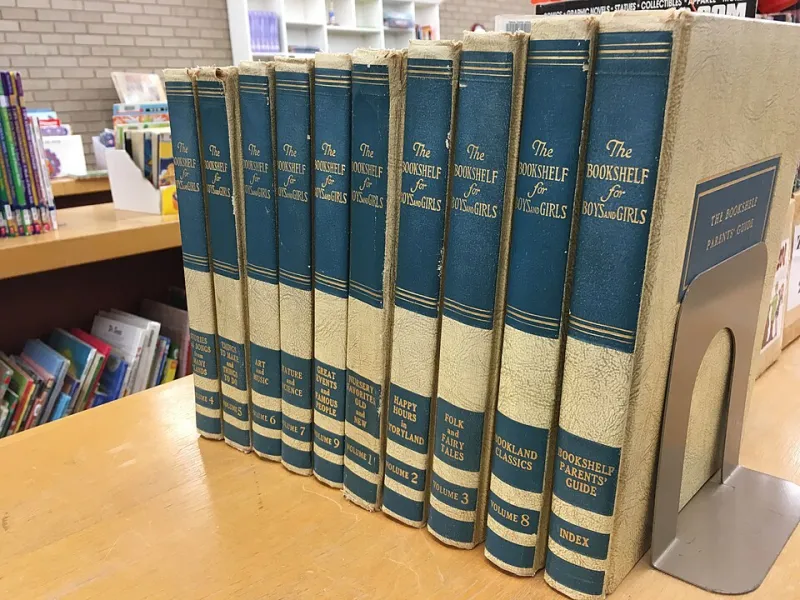
Photo: Texas State Library and Archives Commission from Austin, TX, United States, CC BY 2.0, via Wikimedia Commons
There's a particular memory that millions of American kids share, even if they've never compared notes on it. You're in fourth grade, you have a report due on volcanoes or the Roman Empire or the life cycle of a monarch butterfly, and you pull a heavy volume from the shelf — the one with the gold letter on the spine — and you sit down on the carpet and start reading. The entry is authoritative. It has diagrams. It ends, and that's where knowledge ends too.
The family encyclopedia was, for most of the twentieth century, the closest thing a household had to a complete picture of the world. And families paid accordingly.
The Salesman at the Door
Before the internet made information free, knowledge had a price tag — and encyclopedia companies were not shy about collecting it. Britannica, World Book, Collier's, and Americana all employed armies of door-to-door salesmen who worked American suburbs with evangelical intensity. Their pitch was essentially a moral argument: Don't you want your children to succeed? Don't you want them to have access to the same knowledge as kids from wealthier families?
It worked. A complete set of Encyclopaedia Britannica in the early 1970s cost around $400 — roughly equivalent to $3,000 today. Families bought them on installment plans, the way they bought furniture or appliances. The encyclopedia sat in the living room as both a reference tool and a statement of intent. We are the kind of family that values learning.
Salesmen were trained to close deals in a single visit, because hesitation usually meant a lost sale. Many households that couldn't really afford the sets bought them anyway. The guilt of denying your children access to knowledge was a powerful selling tool, and the companies knew it.
A Snapshot Frozen in Time
Here's the problem that nobody in those living rooms quite wanted to acknowledge: the moment the encyclopedia was printed, it started going stale.
A set purchased in 1968 still listed Lyndon Johnson as president. A 1985 edition didn't know the Soviet Union was six years from collapse. The entry on space exploration ended wherever the print run ended. Supplement volumes were sold annually to patch the gaps, but most families didn't buy them. The encyclopedia on the shelf was a portrait of the world at a single moment, slowly aging in place.
Editors at the major publishers understood this tension acutely. They wrote entries in ways designed to feel timeless — broad, authoritative, slightly abstract — precisely because they knew the facts might drift. It gave the prose a strange quality: confident and complete, but somehow sealed off from the living world outside.
What Looking Things Up Used to Feel Like
Despite the limitations, there was something genuinely valuable about the experience of consulting an encyclopedia. The information was curated by experts. It was organized. It had a beginning and an end. When you read the entry on the Amazon River or the French Revolution, you got a considered, structured account — not a Wikipedia rabbit hole that led you from Marie Antoinette to a forum debate about bread prices in 18th-century Paris.
And there was a physical ritual to it. You had to want to know something badly enough to get up, pull the right volume, find the right page. That friction wasn't entirely bad. It made the act of looking something up feel deliberate, even a little ceremonial. Families gathered around the open book. Arguments were settled with a kind of finality. The encyclopedia says... was a conversation-ender.
Children who grew up with these books often describe a specific kind of accidental discovery — you'd look up one thing and your eye would catch the entry just below it, and suddenly you were reading about something you'd never thought to wonder about before. The serendipity of the physical page was real.
The Collapse Came Fast
In 1993, Microsoft released Encarta — a full encyclopedia on a single CD-ROM that cost about $100. It had audio clips. It had animations. It was searchable. Britannica had taken centuries to build its authority, and a software product priced at one-thirtieth the cost made it feel obsolete almost instantly.
By 2012, Encyclopaedia Britannica announced it would cease print production entirely after 244 years. The door-to-door salesmen were already long gone. World Book hung on longer, sustained largely by school library contracts, but the cultural moment had passed.
Today, Wikipedia — free, perpetually updated, edited by millions — hosts over 6.7 million articles in English alone. The sum of human knowledge is theoretically accessible on a phone in a back pocket. The idea of paying thousands of dollars for a fixed set of books that aged on a shelf seems almost impossible to explain to anyone born after 1995.
The Trade-Off Nobody Warned Us About
What the encyclopedia gave you was limits — and limits, it turns out, have a kind of value. Knowing that the entry on photosynthesis was three pages long meant you could actually finish learning about photosynthesis. Today's information landscape has no such mercy. There is always more. The search results never end. The rabbit holes multiply.
We traded curated authority for infinite access. The bargain made obvious sense. But those twenty-six volumes on the shelf, outdated and expensive and slowly yellowing, gave the world a shape that felt manageable. Knowable. Bounded by a spine on each end.
Some days, that doesn't sound so bad.