Hello Central, Get Me Everyone's Secrets: When Your Phone Operator Knew More About Town Than the Mayor
The Voice That Connected Everything
Betty Jameson could tell you were having an affair before your spouse figured it out. As the head operator at the Millbrook telephone exchange from 1948 to 1967, she didn't need to eavesdrop—though she certainly could. The pattern of your calls told her everything.
 Photo: Betty Jameson, via tiermaker.com
When Harold Mitchell started placing daily calls to a number that wasn't his wife's bridge club, Betty noticed. When those calls grew longer and more frequent, always during his lunch hour, she knew. And when Harold's wife called that same number three weeks later, asking to speak with "the woman my husband has been calling," Betty wasn't surprised.
This was the reality of American telecommunications for most of the 20th century: your most intimate conversations flowed through the ears and hands of women like Betty, who sat at manual switchboards connecting every call in town, one plug at a time.
The Human Internet
Before direct dialing became standard in the 1960s, making a phone call meant talking to an operator first. You'd pick up your receiver, wait for the familiar "Number, please?" and tell a real person where you wanted to connect. In small towns and rural areas, that person was usually one of a handful of local women who worked rotating shifts at the telephone exchange.
These operators weren't just human routers—they were the beating heart of community communication. They knew every voice in town, every family's drama, every business relationship. They could tell you if the person you were calling was home, at church, or visiting relatives three counties over. They knew who was dating whom, who owed money to whom, and who hadn't spoken to whom since the church social incident of 1952.
The operators' knowledge went far beyond gossip. They served as informal emergency dispatchers, connecting frantic callers to doctors, fire departments, or police. They provided directory assistance from memory, often knowing phone numbers better than the people who owned them. During emergencies—fires, accidents, medical crises—they became the crucial link between chaos and help.
The Intimacy of Manual Connection
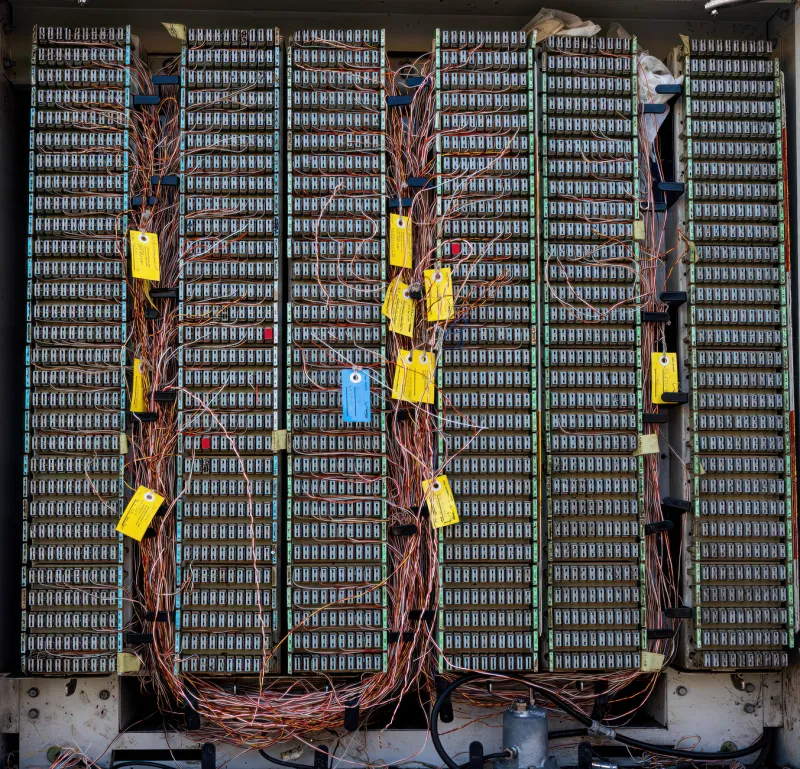
Working a manual switchboard required both technical skill and social intelligence. Operators sat before walls of numbered jacks, each representing a phone line in their coverage area. When someone wanted to make a call, a light would flash next to their number. The operator would plug in her headset cord, take the request, then physically connect the caller to their destination using patch cords.
But the real skill lay in recognizing voices and understanding the social web of their community. Betty Jameson could identify most callers within a word or two. She knew that when Mrs. Patterson called the doctor's office on Tuesday mornings, it was for her arthritis prescription. She knew that calls between the Methodist church and the Baptist church usually meant they were coordinating the annual harvest festival.
This intimate knowledge created a peculiar form of privacy—or rather, the complete absence of it. Operators could listen to any conversation simply by not unplugging their headset. While professional ethics discouraged eavesdropping, the temptation was enormous, and enforcement was nearly impossible. Some operators developed reputations for discretion; others became notorious for spreading what they heard.
When Privacy Was a Party Line
The privacy situation became even more complex with party lines—shared phone connections that served multiple households to reduce costs. Rural families might share a line with three or four neighbors, each assigned a different ring pattern (two long rings for the Johnsons, one short and one long for the Millers).
Party line etiquette required neighbors to limit call duration and avoid picking up during others' conversations. In practice, party lines became informal entertainment networks. Neighbors routinely listened in on each other's calls, creating a constant background awareness of community happenings.
Operators managed this chaos with remarkable skill, keeping track of which families shared lines, monitoring call durations to prevent monopolization, and occasionally breaking into conversations to remind callers that others were waiting to use the line.
The Algorithm Was Human
In many ways, telephone operators functioned as the original algorithm—processing information, making connections, and predicting needs based on patterns and data. But unlike today's digital systems, these algorithms had personalities, biases, and local knowledge.
Betty Jameson knew that when the fire siren went off, she'd receive dozens of calls asking for information. She prepared by calling the fire chief directly, gathering details, and then efficiently distributing updates to concerned callers. When the town's only doctor left for a medical conference, she maintained a list of his temporary replacement's contact information and shared it with anyone who called.
Operators also served as informal social workers. They knew which elderly residents lived alone and might need check-in calls. They recognized the voices of children calling for help and could quickly connect them to appropriate adults. They understood family dynamics well enough to know when to put a call through immediately and when to take a message.
The End of an Era
Direct dialing technology began replacing manual exchanges in major cities during the 1950s, but many small towns didn't convert until the 1960s or 1970s. The transition was often traumatic for communities that had grown accustomed to their operators' personal service.
Sudenly, making a call meant dealing with an impersonal dial tone instead of Betty's familiar voice. There was no one to ask about alternate numbers, to check if someone was home, or to help during emergencies. The social fabric of telephone communication unraveled, replaced by the efficiency of automated systems.
Many former operators struggled to find comparable work. Their unique skill set—combining technical knowledge with intimate community awareness—had no equivalent in the modern economy. The women who had served as the nervous system of American small-town communication found themselves obsolete overnight.
The Echo of Human Connection
Today's communication landscape would be incomprehensible to Betty Jameson's generation. We carry devices that can instantly connect us to anyone, anywhere in the world, without human intervention. We can send messages, share photos, and conduct video calls across continents with the touch of a screen.
Yet something was lost in that transformation. Modern communication is simultaneously more connected and more isolated than the manual telephone era. We can talk to anyone but know our neighbors' voices. We can access infinite information but lack the local knowledge that operators provided. We have privacy but miss the community awareness that came from shared communication channels.
The telephone operators of mid-century America were the last generation of professional eavesdroppers, the final human gatekeepers of community communication. They knew everyone's business because everyone's business literally passed through their hands. In our age of anonymous algorithms and encrypted messages, that level of human-mediated connection seems both quaint and terrifying—a reminder of how fundamentally the nature of privacy, community, and communication has changed in just a few decades.
Betty Jameson retired in 1967, just as direct dialing reached Millbrook. She took with her decades of voices, secrets, and connections that no database could ever capture. The town got more efficient phone service, but it lost something irreplaceable: the human heart of its communication network.